
Carolinas Pain Institute

Blog

How to Find the Right Pain Doctor for You

"How do I find a pain doctor?"

It's the question we hear the most. Whether it's from someone first experiencing pain or someone looking for a specialist, many chronic pain sufferers are seeking the right physician for them.

Here's advice on recognizing the need for a pain doctor, finding a pain management specialist and knowing what questions to ask:

Why seek a pain management specialist

Pain management specialists have special training in evaluating, diagnosing, and treating all types of pain, including acute pain, chronic pain and cancer pain. As the field of medicine learns more about the complexities of pain, it has become more important than ever to have physicians with specialized knowledge and skills to treat all pain conditions.

In addition, the wide variety of treatments available is constantly growing and changing. With an increasing number of new and complex drugs, techniques, and technologies becoming available every year, a pain management physician is uniquely trained to use this new knowledge safely and effectively to help his or her patients.

Finally, a pain management specialist plays an important role in coordinating additional care such as physical therapy, psychological therapy, and rehabilitation programs in order to offer patients a comprehensive treatment plan with a multidisciplinary approach to the treatment of their pain.

Five ways to find a pain management specialist

1. Ask your general practitioner for a pain management physician referral

One of the best ways to find a pain physician is to be referred by your primary care physician. Your local primary care physician probably knows you best and is also connected to a local physician's network. So, he or she can make recommendations based on your individual needs and the doctors in your area.

Most pain physicians work closely with their patients' primary care physicians to ensure good communication, which in turn helps provide the optimum treatment for their patients.

2. Talk to friends

Personal referrals often provide the best leads. Even if someone does not share your pain condition, they may know of someone who does. Ask questions to make sure the recommended physician is a good fit for you.

3. Consult pain advocacy organizations

Many pain advocacy organization websites offer physician directories as well as resources, programs, advocacy and support groups for all kinds of pain conditions. Here are a few organizations that may be helpful to you:

- American Chronic Pain Association
- US Pain Foundation
- Power of Pain Foundation

4. Contact a pain coach

If you know or work with a pain coach, like Take Courage Coaching, ask about a pain management specialist that might be right for you. Many pain management coaches work closely with physicians and may be able to provide referrals.

5. Use online resources

By searching online directories, you can find a pain management specialist near you. You can also find condition-specific groups, organizations, clinics and centers that can lead you to the right pain physician.

Here are some resources and directories:

- PainPathways pain resources
- US News & World Report directory of pain management specialists
- Healthgrades pain medicine directory

Questions to ask a potential pain management specialist

It's important to find someone who has the training and experience to help you with your particular pain issue and with whom you feel a comfortable rapport. Here are some questions to ask:

- How were you trained and are you board certified in pain management? - Do you have experience with my pain condition and what types of treatments do you offer? - Do you only perform procedures or do you use a multidisciplinary approach to pain management? - What types of treatments do you recommend aside from medications or opioids? - What is your overall pain management philosophy? - How can you be reached if questions or problems arise?

Once you find the right pain doctor, take the next step by reading Making the Most of Your Doctor Visit and Ten Techniques to Help Improve the Relationship with Your Doctor.

Finding a pain management specialist is a lot like making a big purchase, do your research, use your network and ask questions to make sure you feel comfortable with your decision. To schedule an appointment with someone on our team, visit:https://carolinaspaininstitute.com/new-patients/
Recommended Posts

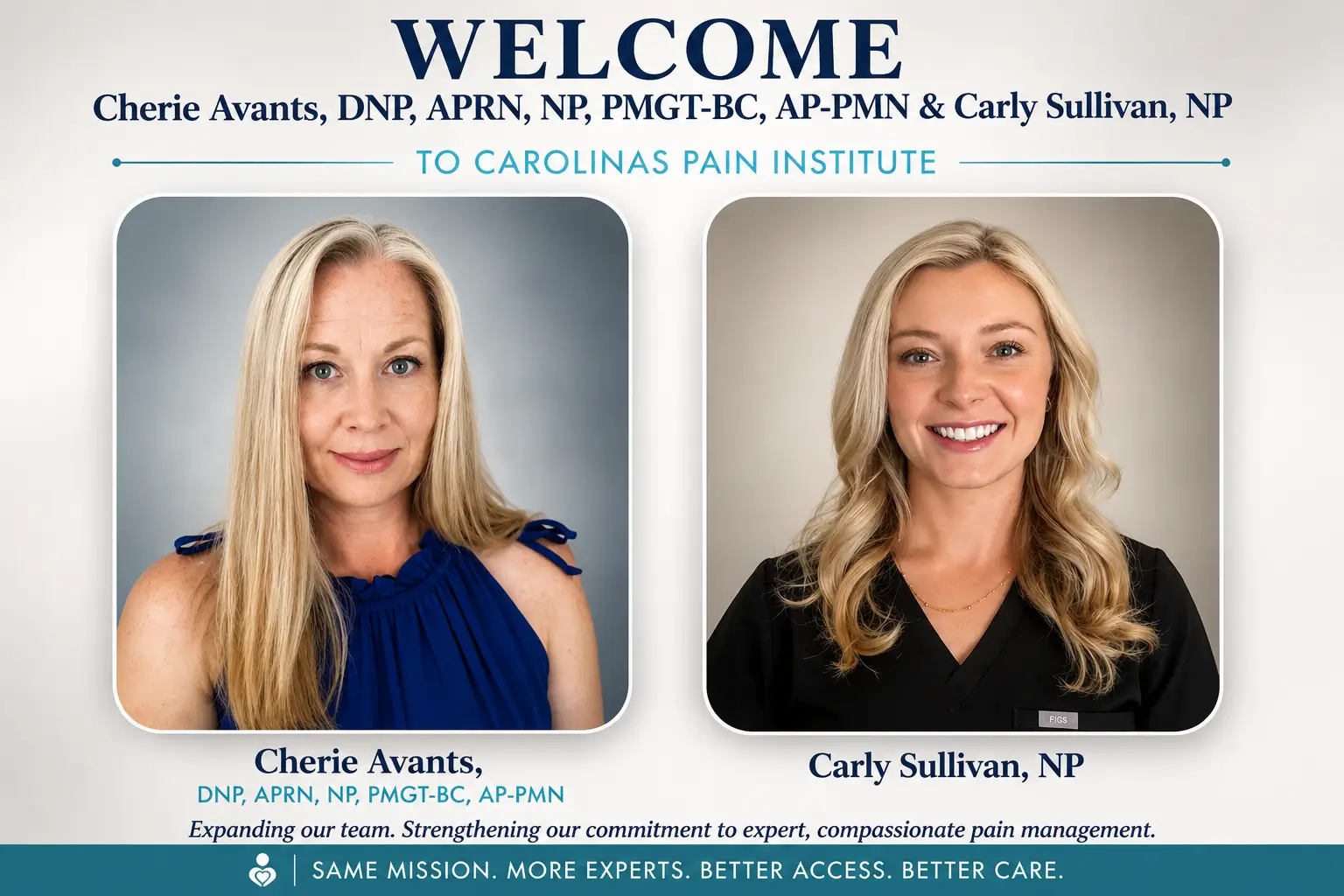
Meet Our New Pain Management Providers: Cherie Advants and Carly Sullivan

New Pain Management Providers | Winston- Salem NC

Expanding Access to Personalized Pain Management in Winston-Salem HERO IMAGE: BOTH PROVIDERS SIDE BY SIDE Growing Our Commitment to Exceptional Patient Care At Carolinas Pain Institute, our mission has always been to provide compassionate, individualized care for patients living with chronic pain. As the need for specialized pain management services continues to grow throughout North Carolina, we remain committed to expanding access to personalized treatment options while maintaining the high level of attention and support our patients deserve. The addition of Cherie Avants, DNP, APRN, NP, PMGT-BC, AP-PMN, and Carly Sullivan, NP, helps our team serve more patients with the timely, comprehensive care they need. By expanding our clinical resources, we can improve appointment availability, reduce wait times, and help patients begin evaluations and treatment sooner. For individuals managing ongoing pain, having access to experienced providers means more opportunities to receive a thorough evaluation, discuss personalized treatment approaches, and develop a care plan tailored to their unique needs. These additions strengthen our ability to continue delivering compassionate, patient-focused pain management throughout the communities we serve. SECTION 2: CHERIE AVANTS Meet Cherie Avants, DNP, APRN, NP, PMGT-BC, AP-PMN Cherie Avants brings a wealth of advanced practice nursing experience to Carolinas Pain Institute, with a clinical background that includes time at Atrium Health Wake Forest Baptist prior to joining our team. Her doctoral-level training as a Doctor of Nursing Practice (DNP) and board certifications reflect a deep, ongoing commitment to advancing her clinical expertise in pain management. Education: Doctor of Nursing Practice (DNP), Duke University School of Nursing Certifications: APRN, NP, board certified in pain management (PMGT-BC), Advanced Practice Pain Management Nursing (AP-PMN) Philosophy of care: Cherie believes every patient deserves a treatment plan built around their unique history, goals, and daily realities — not a one-size-fits-all protocol. Experience treating chronic pain: Compassionate approach: Patients and colleagues alike describe Cherie as an attentive listener who takes the time to explain conditions and treatment options clearly, empowering patients to feel confident and informed in their care. Cherie is now accepting patients in our Winston-Salem office. View Cherie's full bio → SECTION 3: CARLY SULLIVAN Meet Carly Sullivan, NP Carly Sullivan, MSN, APRN, FNP-C, is a Family Nurse Practitioner who is passionate about helping patients improve their quality of life and manage chronic pain. Before becoming a Nurse Practitioner, she gained extensive nursing experience in neurocritical care, intensive care, travel nursing, and perioperative services. Background: Extensive nursing experience in neurocritical care, intensive care, travel nursing, and perioperative services prior to becoming a Family Nurse Practitioner (MSN, APRN, FNP-C) Patient care philosophy: Carly approaches every visit with the belief that patients should feel heard, respected, and actively involved in decisions about their treatment plan. Commitment to individualized care: Rather than applying a standard protocol to every patient, Carly takes time to understand each person's pain history, lifestyle, and goals to build a plan that fits their life — not the other way around. Carly is now seeing patients at Carolinas Pain Institute. View Carly's full bio → CTA Schedule an Appointment Whether you're seeking answers for chronic pain or looking for long-term treatment options, our expanded team is here to help. Winston-Salem Office 145 Kimel Park Drive, Suite 330 Winston-Salem, NC 27103 336-283-2273 Request an Appointment

Understanding Minimally Invasive Spine Procedures for Chronic Back Pain

Chronic back pain can affect nearly every part of your daily routine. Activities that once felt simple, such as walking through the grocery store, sitting at work, exercising, traveling, or spending time with family, may become more difficult when pain continues over time. For many patients, the first steps toward managing spine pain include conservative treatments such as physical therapy, medications, activity modifications, or injections. While these approaches may provide relief for some individuals, others continue to experience symptoms that interfere with their comfort, mobility, and quality of life. Advances in spine care have created additional options for patients who need more targeted treatment. Minimally invasive spine (MIS) procedures are designed to address specific sources of spine-related pain using specialized techniques that focus on the affected area while limiting disruption to surrounding tissues. At Carolinas Pain Institute, our providers take a personalized approach to spine care. Before recommending any treatment, our team works to understand the source of your pain, evaluate your symptoms, and determine which options may be appropriate based on your condition and overall health. If chronic back pain continues despite conservative treatment, learning more about minimally invasive spine procedures may help you better understand your available options. What Are Minimally Invasive Spine (MIS) Procedures? Minimally invasive spine procedures are advanced treatment techniques designed to address certain spinal conditions through targeted approaches rather than traditional open surgical methods. The goal of minimally invasive spine treatment is precision. Instead of treating a broad area, these procedures focus on the specific structures that may be contributing to pain. Depending on the condition being treated, physicians may use specialized instruments, imaging guidance, and advanced techniques to access the treatment area. A common misconception is that all spine pain requires major surgery. However, many spinal conditions require a careful evaluation to determine the most appropriate treatment approach. For some patients, minimally invasive options may provide a way to address specific sources of pain without the same level of disruption associated with larger surgical procedures. Minimally invasive spine procedures may be considered when: A specific source of pain has been identified Conservative treatments have not provided enough relief Symptoms are affecting daily activities Diagnostic testing supports a targeted treatment approach It is important to understand that minimally invasive spine procedures are not appropriate for everyone. The best treatment plan depends on your diagnosis, symptoms, medical history, and individual goals. How Are Minimally Invasive Spine Procedures Different From Traditional Spine Surgery? Many patients hear the term “spine procedure” and immediately think of major surgery and long recovery periods. However, minimally invasive techniques are designed differently. Traditional spine surgery may require larger incisions and greater access to the spine depending on the condition being treated. Minimally invasive approaches use specialized methods to target specific areas while attempting to limit unnecessary disruption to nearby tissues. A More Targeted Treatment Approach One of the biggest differences with minimally invasive spine procedures is the focus on treating the source of pain. Back pain can come from many different structures, including: Spinal discs Nerves Facet joints Vertebral structures Sacroiliac joints Surrounding soft tissues Because different conditions can create similar symptoms, identifying the actual cause of pain is an important part of treatment planning. A targeted procedure is only considered when the provider understands what structure may be contributing to symptoms and whether that area can be addressed through a minimally invasive approach. Less Disruption to Surrounding Tissues Minimally invasive techniques are designed to reduce unnecessary disruption to surrounding muscles and tissues compared with some traditional approaches. The goal is to focus treatment on the problem area while preserving as much healthy tissue as possible. However, every procedure is different, and your provider will explain the expected benefits, risks, and recovery process based on your specific situation. Individualized Recovery Expectations Recovery after a minimally invasive spine procedure varies from person to person. Factors that may influence recovery include: The type of procedure performed The condition being treated Your overall health How long symptoms have been present Your activity level and rehabilitation plan During a consultation, your provider can explain what you may expect before, during, and after treatment. Who May Benefit From Minimally Invasive Spine Treatment? Minimally invasive spine procedures are not designed as a universal solution for all back pain. They are considered for patients who have specific conditions that may respond to targeted treatment. A comprehensive evaluation helps determine whether MIS treatment may be appropriate. Your provider may consider: Where your pain is located How long symptoms have been present Whether pain travels into the legs or other areas Previous treatments you have tried Imaging or diagnostic findings How pain affects your daily activities Patients who may benefit from evaluation include those experiencing: Chronic lower back pain Nerve-related symptoms such as tingling or numbness Pain caused by spinal narrowing Certain disc-related conditions Joint-related spine pain Persistent symptoms despite conservative care The purpose of a consultation is not simply to recommend a procedure. It is to understand your condition and determine the most appropriate path forward. Conditions That May Be Treated With MIS Procedures Different spinal conditions require different approaches. Minimally invasive procedures may be considered for certain patients with specific diagnoses. Lumbar Spinal Stenosis Lumbar spinal stenosis occurs when the spaces within the lower spine become narrowed. This narrowing may place pressure on nearby nerves and contribute to symptoms affecting the lower back and legs. Patients with lumbar spinal stenosis may experience: Lower back discomfort Leg pain Numbness or tingling Weakness Difficulty standing or walking for extended periods Treatment recommendations depend on the severity of symptoms and the underlying cause. For appropriate patients, minimally invasive approaches may be considered as part of a personalized treatment plan. Vertebrogenic Low Back Pain Some chronic lower back pain originates from structures within the vertebrae, including the endplates located near the spinal discs. This type of pain may be associated with changes inside the spine that contribute to ongoing discomfort. For appropriately selected patients, minimally invasive treatments such as basivertebral nerve ablation may be considered. This procedure targets the basivertebral nerve, which may play a role in transmitting certain types of chronic low back pain signals. A thorough evaluation is necessary to determine whether this treatment option is appropriate. Facet Joint Pain Facet joints are small joints located between the bones of the spine that help provide stability and movement. Over time, these joints may become irritated due to: Arthritis Degenerative changes Previous injuries Repetitive stress Facet joint pain may cause: Localized back pain Stiffness Discomfort with certain movements Pain that worsens with standing or bending When evaluation identifies facet joints as a potential source of pain, targeted treatment options may be discussed. Sacroiliac Joint Pain The sacroiliac (SI) joints connect the lower spine to the pelvis. Problems involving these joints may contribute to pain in the lower back, hips, or buttocks. SI joint-related pain may occur due to: Joint irritation Injury Inflammation Changes in movement patterns Proper diagnosis is important because SI joint pain can sometimes feel similar to other types of lower back pain. Why Diagnosis Is the Most Important Step Before MIS Treatment A successful spine treatment plan begins with understanding what is causing your symptoms. Many spine conditions share similar symptoms. For example, lower back pain with leg discomfort may be caused by nerve irritation, spinal narrowing, disc-related problems, or other conditions. During an evaluation, your provider may review: Your symptoms and pain patterns Medical history Previous treatments Physical examination findings Diagnostic imaging This information helps determine whether minimally invasive spine treatment may be appropriate or whether another approach may better address your condition. The goal is to treat the source of pain rather than simply manage symptoms. What Happens During a Minimally Invasive Spine Consultation? A consultation at Carolinas Pain Institute begins with understanding your experience with pain. Your provider may discuss: When your symptoms started What activities increase or decrease discomfort How pain affects your daily life Treatments you have already tried Your goals for care After reviewing your condition, your provider can explain possible treatment options and answer questions about the benefits, risks, and expected outcomes of each approach. Having a clear understanding of your diagnosis and options allows you to make informed decisions about your care..faq-accordion { margin: 40px 0; } .faq-accordion details { border-bottom: 1px solid #d9e2ec; padding: 0; margin-bottom: 15px; background: #ffffff; } .faq-accordion summary { cursor: pointer; list-style: none; padding: 22px 55px 22px 22px; font-size: 20px; font-weight: 600; color: #062b63; position: relative; } .faq-accordion summary::-webkit-details-marker { display: none; } .faq-accordion summary:after { content: "+"; position: absolute; right: 22px; top: 18px; font-size: 28px; font-weight: 300; color: #062b63; } .faq-accordion details summary:after { content: "−"; } .faq-answer { padding: 0 22px 22px; color: #444; font-size: 17px; line-height: 1.7; } .faq-answer p { margin-bottom: 18px; } @media(max-width:768px){ .faq-accordion summary { font-size:18px; padding:18px 45px 18px 18px; } .faq-answer { padding:0 18px 18px; font-size:16px; } } Frequently Asked Questions About Minimally Invasive Spine Procedures Are minimally invasive spine procedures considered surgery? Some minimally invasive spine procedures may be considered surgical interventions, while others are advanced interventional treatments. The classification depends on the specific procedure being performed and the condition being treated. During your consultation, your provider will explain the recommended treatment, what the procedure involves, potential benefits and risks, and what you can expect throughout the process. Are minimally invasive spine procedures safer than traditional surgery? Every medical procedure has potential risks and benefits, and the right treatment option depends on your individual condition. Minimally invasive techniques are designed to target specific areas of the spine while limiting disruption to surrounding tissues when appropriate. Whether a minimally invasive procedure is the right choice depends on factors such as your diagnosis, symptoms, medical history, and previous treatments. A thorough evaluation helps determine the most appropriate approach for your care. How long does recovery take after a minimally invasive spine procedure? Recovery time varies depending on the specific procedure, the condition being treated, and each patient's overall health. Some patients may return to normal activities sooner than others, while additional recovery time may be needed depending on the complexity of treatment. Your provider will discuss expected recovery timelines, activity recommendations, and any follow-up care needed before your procedure. Can minimally invasive procedures help chronic back pain? For appropriately selected patients, minimally invasive spine procedures may help address certain causes of chronic back pain. The effectiveness of treatment depends on identifying the specific source of pain and determining whether the condition is suitable for a targeted procedure. A comprehensive evaluation is an important first step in understanding your symptoms and exploring available treatment options. What if I have already tried other treatments for my back pain? Many patients begin with conservative treatments such as physical therapy, medications, activity modifications, or injections. If these approaches have not provided enough relief, your provider may discuss additional options based on your diagnosis and individual needs. Minimally invasive spine procedures may be one option to consider when appropriate. A personalized evaluation can help determine whether this type of treatment aligns with your condition and goals. Explore Minimally Invasive Spine Options at Carolinas Pain Institute Living with chronic spine pain can be frustrating, especially when symptoms continue despite your best efforts to find relief. Understanding the source of your pain and learning about available treatment options can help you take the next step toward improved comfort and function. At Carolinas Pain Institute, our team provides personalized evaluations and advanced pain management options for patients experiencing chronic spine conditions. If you are exploring minimally invasive spine procedures, our providers can help you understand whether this approach may be appropriate for your condition. Contact Carolinas Pain Institute today to discuss your symptoms and learn more about available spine treatment options.

Sciatica vs. Herniated Disc: What's the Difference?

Sciatica and herniated discs are two terms often used when discussing lower back pain and nerve-related symptoms, but they are not the same condition. A herniated disc can be one of the causes of sciatica, while sciatica describes the symptoms that occur when the sciatic nerve becomes irritated or compressed. Understanding the difference between sciatica and a herniated disc can help you recognize your symptoms and know when to seek medical guidance. At Carolinas Pain Institute, our team provides personalized evaluation and treatment options for patients experiencing nerve-related pain, including sciatica pain relief and treatment in North Carolina. What Is Sciatica? Sciatica refers to pain that follows the path of the sciatic nerve, the largest nerve in the body. The sciatic nerve begins in the lower spine, travels through the hips and buttocks, and extends down each leg. When this nerve becomes irritated or compressed, it can cause: Sharp or burning pain in the lower back Pain that radiates into one leg Tingling or "pins and needles" Numbness Muscle weakness Pain that worsens when sitting Difficulty standing for extended periods Sciatica is a symptom—not the underlying cause of the problem. What Is a Herniated Disc? The spine contains soft cushions called intervertebral discs that sit between each vertebra. These discs help absorb shock while allowing flexibility and movement. A herniated disc occurs when the soft inner material pushes through a tear in the tougher outer layer. If the disc presses against a nearby spinal nerve, it can lead to inflammation, pain, and neurological symptoms. A herniated disc may develop from: Age-related disc degeneration Heavy lifting with poor body mechanics Repetitive spinal stress Sports injuries Falls or motor vehicle accidents Sudden twisting motions Not every herniated disc causes pain. Some people have herniated discs without any symptoms at all. The Main Difference Between Sciatica and a Herniated Disc Although these terms are often used interchangeably, they describe different things. Sciatica Herniated Disc A symptom A structural spinal condition Caused by sciatic nerve irritation Caused by damage to a spinal disc Produces radiating leg pain May or may not cause symptoms Can result from several different conditions One of the most common causes of sciatica Think of it this way: A herniated disc is a potential cause. Sciatica is one possible result. A herniated disc is not the only condition that can cause sciatica. Other causes include spinal stenosis, degenerative disc disease, bone spurs, piriformis syndrome, or spinal injuries. How Symptoms Differ Common Sciatica Symptoms Sciatica symptoms usually affect only one side of the body and include: Shooting pain down the leg Burning sensation Tingling Numbness Weakness in the foot or leg Pain that worsens while coughing or sneezing The pain often follows a very specific path along the sciatic nerve. Common Herniated Disc Symptoms A herniated disc can produce symptoms depending on its location. Symptoms may include: Localized lower back pain Muscle spasms Stiffness Pain with bending Radiating nerve pain Numbness Weakness Some herniated discs never touch a nerve, meaning they may not cause any noticeable symptoms. How Symptoms Differ Common Sciatica Symptoms Sciatica symptoms usually affect only one side of the body and include: Shooting pain down the leg Burning sensation Tingling Numbness Weakness in the foot or leg Pain that worsens while coughing or sneezing The pain often follows a very specific path along the sciatic nerve. Common Herniated Disc Symptoms A herniated disc can produce symptoms depending on its location. Symptoms may include: Localized lower back pain Muscle spasms Stiffness Pain with bending Radiating nerve pain Numbness Weakness Some herniated discs never touch a nerve, meaning they may not cause any noticeable symptoms. Can Sciatica Be Prevented? While not every case is preventable, healthy habits may reduce your risk. Helpful strategies include: Maintaining a healthy weight Exercising regularly Strengthening core muscles Using proper lifting techniques Avoiding prolonged sitting Practicing good posture Staying physically active throughout the day These habits also support overall spinal health and may lower the risk of developing disc-related problems. Experiencing Sciatica or Nerve Pain? Understanding whether your symptoms are caused by sciatica, a herniated disc, or another spinal condition is an important first step toward finding relief. At Carolinas Pain Institute, our providers evaluate the source of your pain and create personalized treatment plans based on your symptoms, health history, and goals. If you are looking for sciatica pain relief and treatment in North Carolina, contact Carolinas Pain Institute today to schedule an evaluation.